
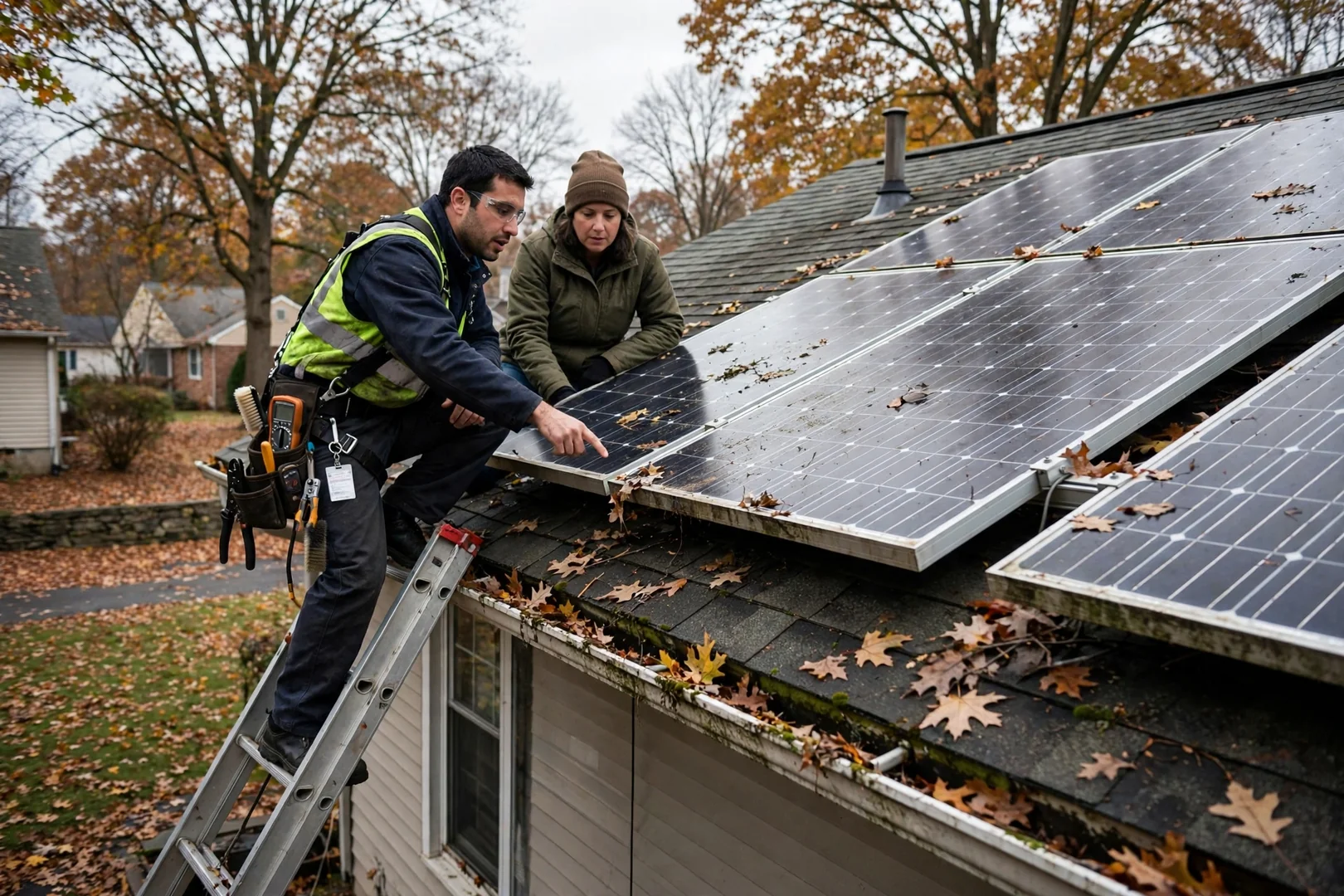
Most residential arrays benefit from a full service inspection once a year, with a second visit after severe weather or if production monitoring shows a sustained drop. Annual visits cover torque checks on racking hardware, DC connector inspection, grounding continuity, and inverter firmware and fault log review. Systems shaded by mature oaks and maples often need more frequent panel cleaning because pollen and leaf tannin residue reduce irradiance reaching the cells.
Solar Repair and Maintenance in Wayne, NJ
Solar repair and maintenance covers diagnostic testing, cleaning, and component replacement for photovoltaic systems that are underproducing, faulting, or aging, and it applies to homeowners, landlords, and facility managers across Wayne who depend on steady output. Properties shaded by mature oaks along the Passaic River corridor collect pollen, leaf tannin, and ice-dam runoff that dull panel glass and stress roof penetrations. Our technicians run string-level voltage checks, inspect MC4 connectors and rapid-shutdown devices, verify inverter firmware, and use thermal imaging to locate hot spots and microcracks before production losses widen. Scheduling for 2026 spring and fall service windows is open now, which is when winter freeze-thaw damage and summer heat degradation are easiest to catch. Wayne Solar Panel Installations handles the inspection, the repair, and the written findings that follow.
Click Me to Call: (973) 922-9275Request Service
Send your system details and a technician will follow up with a written estimate.
Solar Service and Maintenance Overview
What Our Solar Repair and Maintenance Service Includes
Solar repair and maintenance is the process of inspecting, testing, cleaning, and repairing photovoltaic arrays, inverters, wiring, and mounting hardware so a system holds its rated output, and at Wayne Solar Panel Installations it includes scheduled servicing and fault correction across Wayne properties. Technicians begin with a production review against monitoring data, then move to on-array work: irradiance and string voltage readings, insulation resistance testing, torque checks on rail clamps and L-feet, and inspection of flashing and roof penetrations for water intrusion. Thermal imaging identifies bypass diode failures, cell hot spots, and loose terminations that monitoring alone will not isolate. Panel surfaces are cleaned with deionized water and soft brushes rather than pressure washing, which protects anti-reflective coatings and frame seals.
Single-family homes, condominium buildings, and commercial rooftops each carry different access, load, and disconnect requirements, so scopes are written per property rather than applied as a template. Local conditions drive the schedule. Heavy tree cover, spring pollen, summer humidity, and the freeze-thaw cycling common to northern New Jersey winters accelerate soiling, connector corrosion, and sealant fatigue on older arrays. Our 2026 maintenance plans pair a post-winter inspection with a late-summer check before heating season demand rises, and every visit ends with a written findings report and a walkthrough of any recommended repairs.
Book Maintenance Service (973) 922-9275What Signs Mean Your Property Needs Solar Repair and Maintenance?
Declining kilowatt-hour production, inverter fault codes, tripped rapid-shutdown devices, and visible panel damage are the clearest signs a system needs professional repair and maintenance. Monitoring portals often flag the problem first: one string reporting lower voltage than its neighbors usually points to a failed bypass diode, a corroded MC4 connector, or shading from limb growth. Homeowners in Wayne also report inverters that cycle off during afternoon heat, ground-fault alarms after heavy rain, and delamination or snail-trail discoloration along panel edges. Loose rail clamps and backed-out lag bolts are another frequent finding, especially on arrays that have absorbed several seasons of wind loading and snow slide.
Environmental exposure explains most of it. Pollen film in spring, tree debris in autumn, and ice buildup at the array edge each reduce irradiance reaching the cells while trapping moisture against frames and junction boxes. Systems installed a decade or more ago are now reaching the point where inverter capacitors and rooftop conduit seals need attention, and that pattern is showing up consistently through 2026 service calls. Small faults compound quietly. Scheduled repair and maintenance restores measured output, documents component condition in writing, and keeps warranty obligations intact before a minor defect becomes a full array replacement.
Solar Repair and Maintenance FAQs for Wayne Homeowners
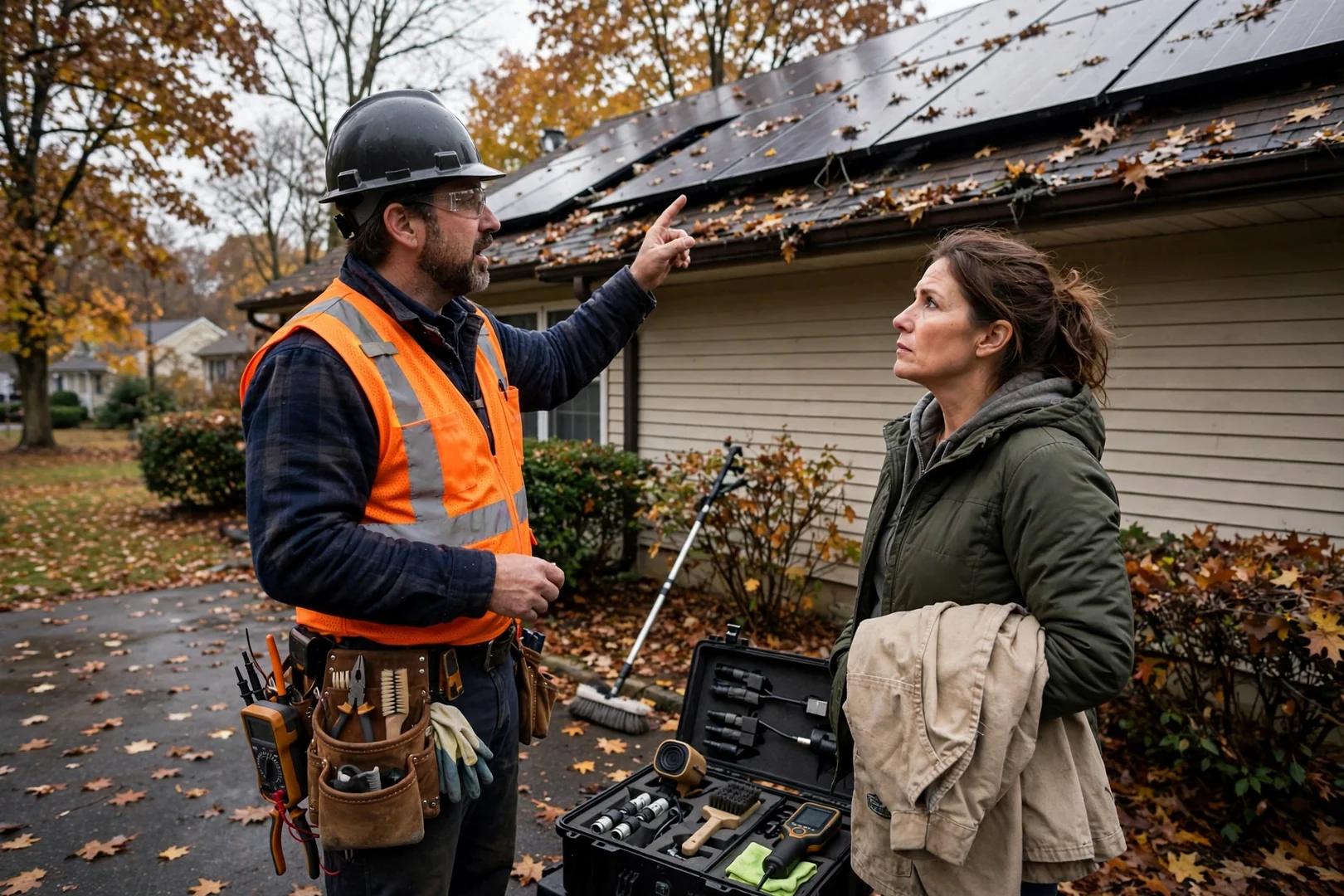
Answers below address the service questions Wayne property owners raise most often in 2026, from inspection scheduling and inverter fault codes to seasonal soiling, string testing, and written repair documentation.
A standard maintenance visit includes module-level visual inspection, string voltage and amperage testing, thermal scanning for hot spots, inverter and rapid shutdown verification, combiner and junction box inspection, mounting hardware torque checks, and array washing when soiling is present. Technicians also review monitoring data against expected kilowatt-hour output to identify underperforming strings. Findings are documented in a written report with photographs and any recommended repairs listed separately.
Preparation is minimal: clear vehicle access to the driveway, unlock gates or utility areas, and make sure the inverter, combiner, and main service panel are reachable. Having your monitoring portal login or recent production statements available speeds up diagnostics considerably. If roof access requires moving patio furniture, planters, or ladders stored along the eaves, handling that beforehand keeps the visit on schedule.
Routine maintenance is priced around array size, roof pitch and access difficulty, and the number of strings and inverters to be tested, while repairs depend on the failed component and the diagnostic work required to isolate it. A corroded MC4 connector or a failed optimizer is a different scope than an inverter replacement or reflashing conduit penetrations. Wayne homes with steep or multi-plane roofs may require additional fall protection setup, which affects labor time.
Conditions across Wayne place specific stress on solar equipment: freeze-thaw cycling loosens flashing and racking fasteners, humid summers accelerate oxidation at DC connectors and grounding lugs, and heavy tree canopy in older neighborhoods contributes to soiling and localized shading losses. Snow and ice loading also shift panel clamps slightly over successive winters. Service schedules in 2026 are generally built around spring pollen season and late-fall leaf drop, when array performance dips most noticeably.
How Much Does Solar Repair and Maintenance Cost in Wayne?
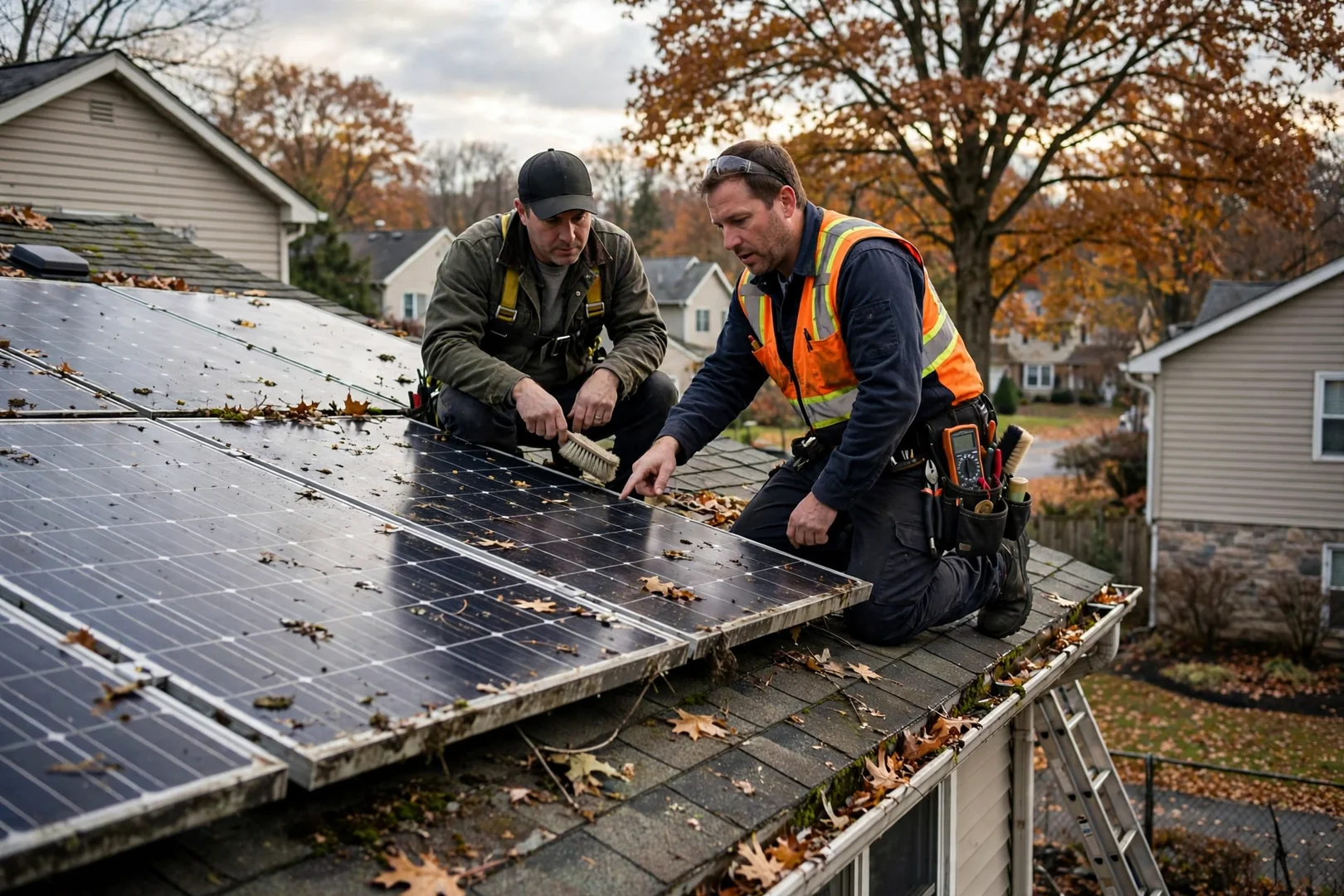
Solar repair and maintenance pricing in Wayne depends primarily on array size, roof access and pitch, the number of inverters or optimizers involved, and whether the visit is scheduled maintenance or fault diagnostics, with most 2026 jobs falling within predictable local ranges for each scope. Routine service is calculated from module count, string configuration, and the testing sequence required, including insulation resistance checks and thermal imaging. Repairs are priced by component: MC4 connectors, rapid shutdown devices, module-level power electronics, and string inverters each carry different parts and labor requirements. Access matters too. Steep roofs, multi-plane layouts, and ground-mount arrays with heavier vegetation around the racking add setup and fall-protection time.
Diagnostic depth also influences cost, since intermittent inverter fault codes and partial string losses take longer to isolate than a single visible failure point. Warranty status on modules and inverters can shift parts responsibility to the manufacturer, which we verify before quoting. Because roof condition, wiring runs, and equipment age vary widely across Wayne properties, accurate numbers require an on-site assessment rather than a phone estimate. Every scope is delivered as a free written estimate itemizing labor, parts, and testing, followed by a post-job walkthrough of the completed work.
How Do We Perform Solar Repair and Maintenance in Wayne?
01
Monitoring Review and Intake
Work begins with a review of production data, inverter fault logs, and system documentation before anyone reaches the roof. Comparing actual kilowatt-hour output against expected yield narrows the likely fault to a string, an optimizer, or the inverter itself. This step shortens diagnostic time on site.
02
On-Site Safety Setup and Array Inspection
Technicians establish roof access, set fall protection, and confirm rapid shutdown function before opening any electrical enclosure. A module-by-module visual inspection follows, checking for cell cracking, delamination, backsheet damage, and hardware movement caused by freeze-thaw cycling common on Wayne rooftops.
03
Electrical Testing and Diagnostics
String voltage, operating current, and insulation resistance are measured against design values, with thermal imaging used to locate hot spots at cells, connectors, and terminations. Combiner boxes, grounding lugs, and MC4 connections are inspected for oxidation and arcing signs. Findings are recorded as measured values, not impressions.
04
Repair, Cleaning, and Component Replacement
Approved repairs proceed in sequence: replacing failed connectors or optimizers, re-torquing racking hardware, resealing roof penetrations, and swapping inverters when fault history warrants it. Array washing removes pollen film and leaf residue that suppress irradiance. All work follows manufacturer specifications and NEC requirements.
05
Verification and Written Documentation
Post-repair commissioning confirms restored output, clean fault logs, and correct communication with the monitoring platform before the crew leaves. Homeowners receive a written service report with photographs, measured test values, and recommended maintenance intervals. A post-job walkthrough closes out the visit.
Why Do Wayne Homeowners Trust Us for Solar Repair and Maintenance?
Call Us: (973) 922-9275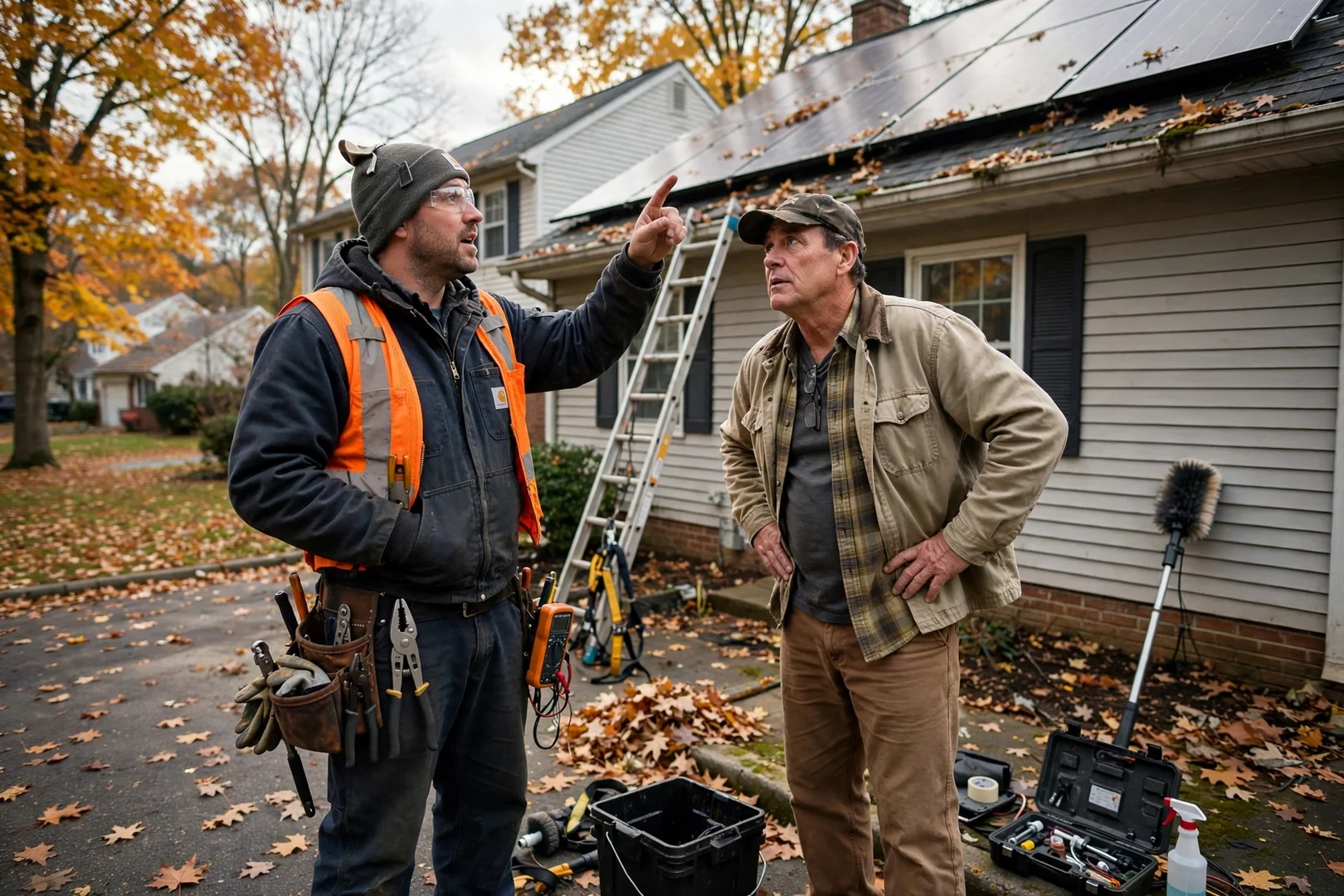
Focused Solar Repair and Maintenance Advice. We match recommendations to your actual property conditions instead of using a one-size-fits-all package.
Clear Communication. You know what is being installed, why it matters, and how to maintain it after the visit.
Local Follow-Through. Our team supports homeowners and businesses in Wayne, NJ before, during, and after the job.
Book Solar Repair and Maintenance
Schedule Solar Repair and Maintenance in Wayne
Requesting service begins with a written estimate issued at no cost and with no obligation to proceed. Our technicians review inverter fault logs, string voltage readings, module condition, and racking hardware before recommending any repair, so the scope you approve reflects the actual condition of the array. Maintenance calendars fill quickly ahead of the humid summer and freeze-thaw cycles that stress rooftop systems across Wayne, and 2026 inspection slots are being assigned now. Scheduling is handled promptly, and every visit closes with a walkthrough of findings and completed work. Call or email to reserve an inspection date and keep your production numbers where they belong.
Request Your Free Estimate (973) 922-9275