
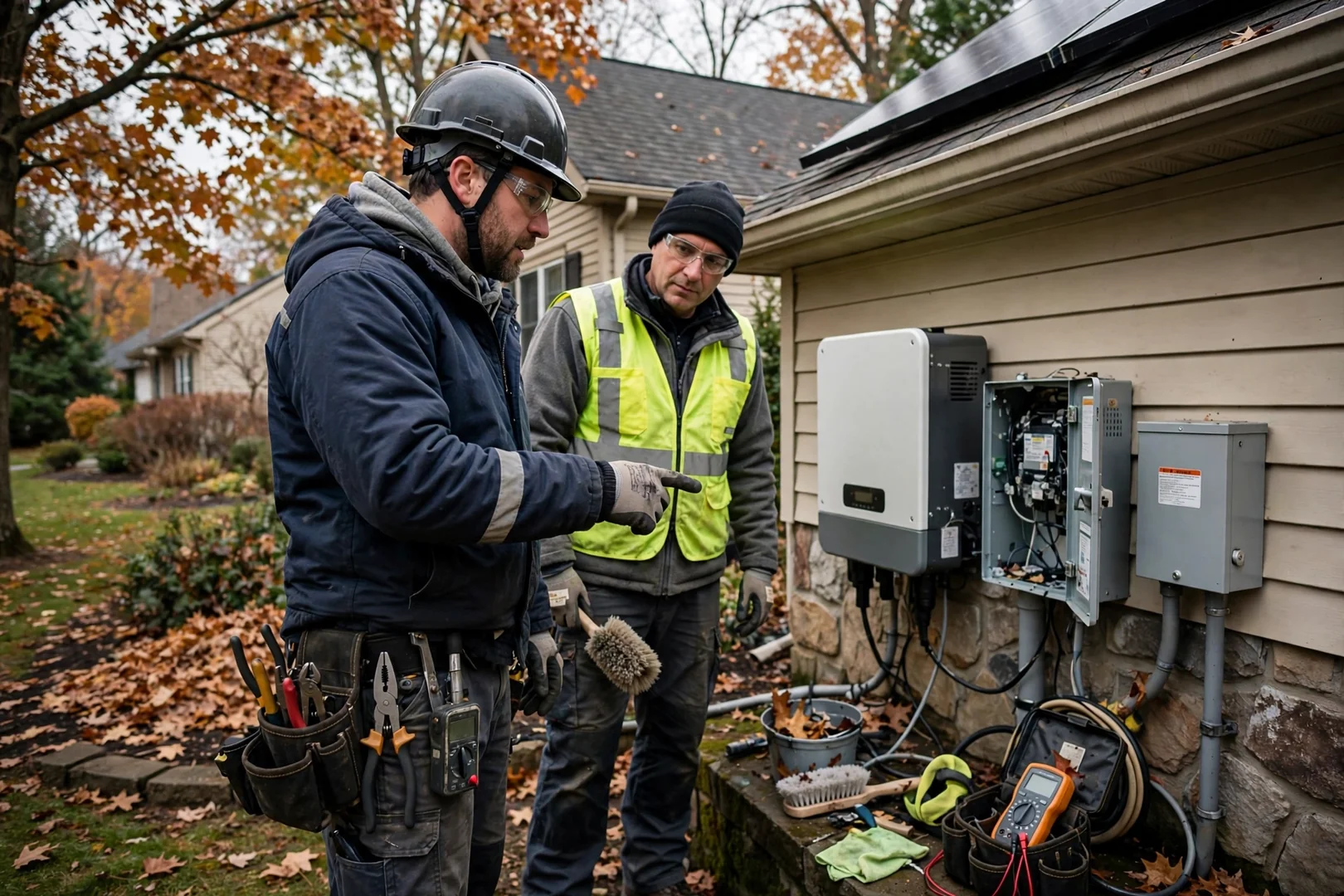
A residential hybrid solar installation is typically completed across two to four working days on site, with the array mounting, hybrid inverter placement, and battery commissioning handled in sequence rather than all at once. Township permitting and utility interconnection review are scheduled ahead of the install date, so crews arrive with approvals already in motion. Weather windows matter in Wayne, and roof work is rescheduled when conditions make racking and flashing installation unsafe.
Hybrid Solar Systems in Wayne, NJ
Hybrid solar systems pair grid-tied production with battery storage, allowing a home or business to draw from panels, stored capacity, or utility power depending on demand and outage conditions. Homeowners across Wayne choose this configuration because tree-shaded lots near the Passaic River basin and heavy nor’easter activity make grid interruptions a practical concern rather than a rare one. Our technicians size the hybrid inverter, configure critical load panels, and set depth-of-discharge limits based on actual consumption data instead of generic averages. Scheduling for 2026 installations is open, with system design reviews arranged ahead of the spring production season. Wayne Solar Panel Installations handles the full sequence, from load audit through permitting, commissioning, and a post-job walkthrough of the monitoring platform.
Click Me to Call: (973) 922-9275Request System Design Review
Share a few details and a technician will follow up with a written estimate.
Hybrid Solar Systems Explained
What Our Hybrid Solar Systems Service Includes
A hybrid solar system is a photovoltaic array combined with battery storage and a bidirectional inverter that manages power flow between panels, batteries, and the utility grid, and at Wayne Solar Panel Installations it includes load auditing, system sizing, hybrid inverter installation, critical load subpanel wiring, permitting, and commissioning across Wayne properties. Design begins with an energy consumption review and a shading analysis, since mature oak and maple canopies common on older residential streets reduce winter yield more than most owners expect. Technicians then specify inverter capacity, string configuration, and usable battery kilowatt-hours, mapping essential circuits such as well pumps, sump pumps, refrigeration, and heating controls to the backup panel. Mounting hardware and conduit routing are selected for freeze-thaw cycling and roadway salt exposure, which shorten the service life of undersized fasteners and unrated enclosures.
Installations serve single-family homes, townhouse associations, multi-unit buildings, and small commercial properties, each with different interconnection and metering requirements. Our 2026 designs weight late-summer storm activity and shorter winter production days heavily, because those two periods define how a battery bank actually performs here. Commissioning includes inverter firmware verification, transfer testing under simulated outage, and torque checks on all DC terminations. Every project closes with a written system summary and a walkthrough of the monitoring portal. Seasonal maintenance intervals are set from the start.
Discuss Your System (973) 922-9275What Signs Mean Your Property Needs a Hybrid Solar System?
Repeated grid outages, an aging string inverter with no storage capability, and export credits that no longer offset winter consumption are the clearest indicators that a property needs a hybrid solar system. Owners in Wayne often notice the pattern first during summer thunderstorm season, when limbs come down on distribution lines and a grid-tied array shuts off through anti-islanding protection even in full sun. Other symptoms include sump pumps going idle during heavy rain events, well water loss on outage days, and net metering statements showing high nighttime draw at full retail rates. Older grid-tied arrays also reveal themselves through inverter fault codes, declining string voltage, and monitoring gaps that go unexplained for weeks.
Storage-related complaints follow a similar pattern. Undersized battery banks discharge past healthy depth-of-discharge limits, backup panels carry circuits that were never prioritized correctly, and transfer times are long enough to reset furnace controls and HVAC boards. Cold snaps compound the issue, since lithium cells throttle charge acceptance below certain temperatures and unconditioned garage installations lose usable capacity. Heading into 2026, more properties are pairing existing arrays with hybrid inverters rather than replacing modules outright. A hybrid configuration resolves these issues by adding managed storage, automatic islanding, and prioritized load control. We document the recommended scope in writing before any work begins.
Hybrid Solar Systems FAQs for Wayne Homeowners
These answers address the questions Wayne property owners raise most often about hybrid solar in 2026, from battery sizing and transfer switch behavior to scheduling, site preparation, and long-term system upkeep.
A standard hybrid installation includes the panel array and racking, a hybrid inverter capable of managing both grid and battery power, the battery enclosure and DC wiring, a critical loads subpanel or automatic transfer switch, rapid shutdown devices, monitoring setup, and full commissioning documentation. Technicians also verify grounding, conductor sizing, and depth of penetration seals before energizing. A written scope is provided before work begins so every component and connection point is accounted for.
Preparation is limited to clearing access, which means providing a clear path to the main service panel, the planned battery wall or pad location, and the roof access point. Garage and basement areas often host the hybrid inverter and battery, so removing stored items from those walls speeds the mounting stage. Our team confirms parking, ladder placement, and a brief power interruption window with you in advance of the interconnection tie-in.
Hybrid systems carry additional cost because they add lithium iron phosphate battery storage, a bidirectional hybrid inverter, and backup load management hardware that a straight grid-tied array does not require. Labor also increases, since the critical loads subpanel must be built out and each backup circuit isolated and tested. Site conditions such as panel capacity, conduit runs, and battery placement affect the final figure, which is why a written estimate follows an on-site assessment.
Shorter winter production days and heavy tree canopy across older Wayne neighborhoods make battery reserve sizing and depth-of-discharge planning more important than in open, unshaded regions. Snow loading, ice shedding, and freeze-thaw cycles influence racking selection and tilt, while cold ambient temperatures affect battery charge acceptance rates. Systems designed here in 2026 are modeled against seasonal irradiance data and local outage patterns, not generic national averages.
How Much Does a Hybrid Solar System Cost in Wayne?
Hybrid solar pricing in Wayne depends primarily on array size in kilowatts, usable battery storage capacity, and the complexity of the electrical service tie-in, with most 2026 projects priced after a full site assessment rather than from a flat rate. Battery chemistry and capacity carry the largest share of the difference, since a single lithium iron phosphate module supporting essential circuits costs far less than a multi-module bank sized for whole-home backup. Hybrid inverter selection matters as well, because units with higher continuous output and greater surge capacity for well pumps or HVAC compressors sit at a higher tier. Roof-specific labor also factors in: rafter spacing, penetration flashing, conductor runs, and whether a main panel upgrade or new critical loads subpanel is required.
Ground-mount alternatives introduce trenching and footing work that changes the labor calculation entirely. Older homes across the township frequently need service panel work before storage can be added safely. Every figure is documented. Following the on-site evaluation, we provide a free written estimate itemizing equipment, labor, permitting, and interconnection steps so the numbers can be reviewed line by line before any work is scheduled.
What Are the Steps in Our Hybrid Solar Process?
01
Site Assessment and Load Analysis
Technicians measure roof planes, evaluate rafter condition, review shading from mature tree canopy, and inspect the main service panel. Consumption history is analyzed to identify which circuits belong on backup and how much usable storage the household actually needs.
02
System Design and Documentation
Array layout, hybrid inverter capacity, and battery bank sizing are modeled together against seasonal production estimates. You receive a written design package covering equipment specifications, string configuration, critical loads planning, and a line-item estimate before approval.
03
Permitting and Utility Interconnection
We prepare township permit submittals and the utility interconnection application, including single-line diagrams and equipment cut sheets. Inspection scheduling is coordinated so the install window aligns with approval timelines rather than working against them.
04
Installation and Wiring
Racking and flashing go in first, followed by module mounting, rapid shutdown devices, and DC conductor runs. The hybrid inverter, battery enclosure, and critical loads subpanel are then installed, with grounding, conduit support, and torque values verified at each termination.
05
Commissioning and Walkthrough
Commissioning includes firmware configuration, charge and discharge testing, transfer switch verification under simulated outage, and monitoring activation. A post-job walkthrough covers battery reserve settings, app access, and maintenance expectations, along with all documentation.
Why Do Wayne Homeowners Trust Us for Hybrid Solar Systems?
Call Us: (973) 922-9275
Focused Hybrid Solar Systems Advice. We match recommendations to your actual property conditions instead of using a one-size-fits-all package.
Clear Communication. You know what is being installed, why it matters, and how to maintain it after the visit.
Local Follow-Through. Our team supports homeowners and businesses in Wayne, NJ before, during, and after the job.
Free Hybrid Solar Estimates
Schedule Hybrid Solar Systems in Wayne for 2026
Planning a hybrid solar system for the 2026 season starts with a site review of your roof plane, panel capacity, and battery placement options. Our technicians provide free written estimates that itemize inverter selection, storage sizing, and interconnection requirements, with no obligation to move forward. Scheduling is straightforward, and assessments are arranged around your availability so design work can begin before Wayne enters its heavier winter load period. Every proposal includes a post-installation walkthrough of monitoring, transfer settings, and maintenance intervals. Call or email to reserve an assessment date.
Request Your Free Estimate (973) 922-9275